Down Payment Assistance
Down Payment Assistance Types
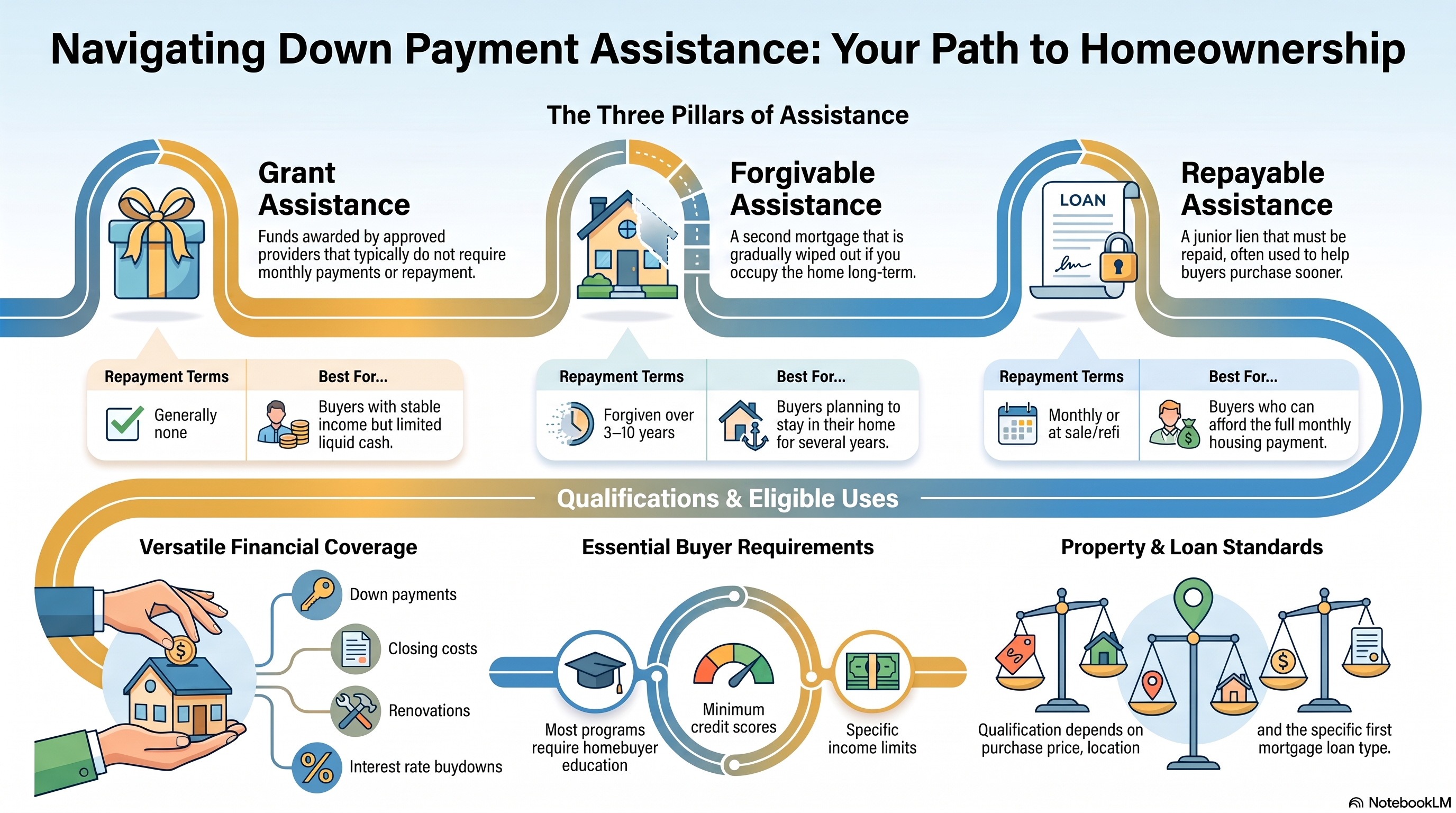
Down payment assistance is not a single product but a category of help available from various sources, including state, county, city, nonprofit, housing finance agencies, employers, CDFIs, and Federal Home Loan Banks. It can cover down payments, closing costs, renovation costs, or even permanent interest rate buydowns. Fannie Mae’s Community Seconds guidance outlines acceptable uses, including down payment, closing costs, renovations, and permanent buydowns, subject to program and loan rules.
The three main categories for consumer education are:
- Grant assistance
- Forgivable assistance
- Repayable assistance
It’s important to note that not all down payment assistance is free money. Some is grant-based, some is forgiven over time, and some must be repaid. Freddie Mac describes DPA as grants, second mortgage loans, and tax credits, with second mortgage loans often carrying low or zero interest and payments that may be deferred or forgiven over time.
Grant assistance is typically awarded by an approved provider and applied toward the buyer’s required funds to close. The money may be used for the down payment, closing costs, or both, depending on program rules. Common sources include housing finance agencies, local governments, nonprofit organizations, employer assistance programs, community development organizations, and Federal Home Loan Bank affordable housing programs. Fannie Mae’s Community Seconds guidance allows funding from sources such as federal agencies, state or local government entities, housing finance agencies, 501(c)(3) nonprofits, Federal Home Loan Banks, employers, and certain tribal entities.
Buyers receive help with upfront funds without taking on a monthly payment or a repayable second mortgage. This can be especially helpful for buyers with stable income but limited liquid cash. Most grant programs include income limits, first-time homebuyer requirements, owner-occupancy requirements, homebuyer education, approved lender requirements, minimum credit scores, debt-to-income limitations, purchase price limits, property type restrictions, and a primary residence requirement. Some grants may have repayment triggers if the buyer sells, refinances, moves out, or violates occupancy requirements before a certain period.
Grant assistance is best suited for buyers with stable income, who can qualify for the mortgage payment, have limited cash saved, plan to occupy the home as a primary residence, and are comfortable meeting program requirements. A grant is usually the cleanest type of down payment help because it may not need to be repaid, but the buyer and property must qualify, and some programs require the buyer to live in the home for a certain period of time.
Forgivable assistance is typically structured as a second mortgage or subordinate lien that is forgiven over time, as long as the buyer follows the program rules. It may start as a loan and then gradually disappear if the buyer meets the occupancy and time requirements. The second mortgage may have no monthly payment, zero percent interest, deferred payments, a forgiveness schedule, and a required occupancy period. Example structures include forgiveness of 20% per year over 5 years, 10% per year over 10 years, or full forgiveness after 3, 5, or 10 years. These are examples only, and each program has its own terms.
Forgivable assistance can provide a larger amount of help than a simple grant, while still avoiding a monthly payment in many cases. The buyer may get into the home with less upfront cash, and the assistance may eventually be wiped out if they stay in the home long enough. However, forgivable does not mean automatically forgiven. If the buyer sells, refines, moves out, or violates the program rules before the forgiveness period ends, some or all of the assistance may need to be repaid. Forgivable assistance is best suited for buyers who plan to stay in the home for several years, need help with cash to close, understand the repayment triggers, are buying a primary residence, and are comfortable with a second lien.
Repayable assistance is down payment or closing cost help that must be repaid. It is often structured as a second mortgage behind the buyer’s main mortgage. The CFPB explains that a second mortgage, also called a junior lien, is a loan taken out using the home as collateral while another loan is already secured by the home. Repayable assistance can be structured in several ways, including monthly payment second mortgages, deferred payment second mortgages, balloon payment assistance, and low or zero interest second mortgages. The key benefit is that it can help a buyer purchase sooner by reducing upfront cash needed, but it is not free money.
Repayable assistance is best suited for buyers who can afford the full housing payment, need help with upfront funds, understand the repayment terms, have a stable income, plan around future refinance or sale implications, and do not treat the assistance as free money. The main caution is that it increases overall debt and may increase monthly payments. It also notes that some local nonprofit or government organizations may offer second mortgages on special terms to replace a down payment.
Down payment assistance can help cover down payments, closing costs, prepaids, discount points, permanent interest rate buydowns, renovation costs, and certain affordability subsidies. Fannie Mae’s Community Seconds rules allow eligible assistance to be used for down payment, closing costs, renovations, and permanent interest rate buydowns, subject to program requirements. Most DPA programs look at income, household size, first-time homebuyer status, credit score, debt-to-income ratio, employment history, homebuyer education completion, primary residence intent, available assets, and prior homeownership history. Property factors include purchase price, location, type, occupancy, appraised value, condition, and whether the property meets first mortgage guidelines. Loan factors include loan type, first mortgage approval, lender approval, investor overlays, assistance source approval, CLTV/TLTV limits, AUS findings, subordinate lien terms, and whether the program can be combined with the selected first mortgage.
Buyers may need several documents, including a DPA application, income documentation, asset documentation, homebuyer education certificate, program approval letter, award letter, second mortgage note, subordinate mortgage or deed of trust, program disclosures, occupancy certification, purchase contract, first mortgage approval, final closing disclosure, and source of funds documentation. It is important to avoid making misleading statements such as “free money,” “everyone qualifies,” “no money down,” “guaranteed approval,” or “this program will cover everything.” Instead, use better language such as “assistance may be available for qualified buyers,” “program availability, funding, and eligibility vary,” and “the buyer and property must qualify.”
Not every buyer needs more savings. Some need the right strategy. Many buyers assume they cannot purchase because they do not have enough saved for the down payment. The truth is, some qualified buyers may have access to assistance programs that can help with down payment or closing costs. But DPA is not one-size-fits-all. Some programs are grants, some are forgivable second mortgages, and some are repayable second mortgages. The structure matters because it affects the buyer’s future flexibility, refinance options, and total cost. Before your buyer sidelines themselves over the down payment, let’s check whether there is a smarter way to structure the file.
Down payment assistance can help qualified buyers reduce the cash needed to buy a home. The three main types are grants, forgivable assistance, and repayable assistance. Grants may not need to be repaid. Forgivable assistance may be wiped out over time if the buyer follows the rules. Repayable assistance must be paid back, either monthly or later when the home is sold, refinanced, or paid off. The right option depends on the buyer, property, loan type, and program guidelines. DPA does not automatically mean a weak buyer. It means the file needs to be structured correctly. The big question is not just, “Does the buyer qualify for assistance?” It is, “What type of assistance is it, how does it affect the approval, and will it create any issues with the offer, closing, or future refinance?”
Down payment assistance may be available to qualified buyers through approved government, nonprofit, employer, housing finance agency, or community-based programs. Program availability, funding, income limits, property eligibility, assistance amount, repayment terms, forgiveness terms, and borrower qualification requirements vary. Assistance may be structured as a grant, forgivable second mortgage, deferred second mortgage, or repayable loan. Not a commitment to lend. All loans are subject to credit, income, asset, property, program, and underwriting approval.
Down Payment Assistance FAQ
1. What is down payment assistance?
Down payment assistance is help that may reduce the amount of money a qualified buyer needs to bring to closing. Depending on the program, it may help cover the down payment, closing costs, or both.
2. Is down payment assistance free money?
Not always. Some assistance comes as a grant, some is forgiven over time, and some must be repaid. The structure matters, so buyers should understand the terms before assuming it is free money.
3. What are the main types of down payment assistance?
The three main types are grants, forgivable assistance, and repayable assistance. Grants usually do not need to be repaid if program rules are met. Forgivable assistance may be erased over time. Repayable assistance must be paid back either monthly or later.
4. Who usually qualifies for down payment assistance?
Qualification depends on the program. Common factors include income, credit score, household size, property location, purchase price, loan type, and whether the home will be used as a primary residence.
5. Do I have to be a first-time homebuyer?
Sometimes, but not always. Many programs are designed for first-time homebuyers, but some may also be available to repeat buyers. It depends on the specific program guidelines.
6. Can down payment assistance be used for closing costs too?
Yes, some programs allow assistance to be used toward closing costs in addition to the down payment. The exact use of funds depends on the program and loan guidelines.
7. Does using down payment assistance make my offer weaker?
Not automatically. A buyer using assistance can still be a strong buyer if they are properly approved, well-documented, and working with a lender who can clearly communicate the strength of the file.
8. What happens if I sell or refinance after using assistance?
It depends on the type of assistance. Some programs may require repayment if you sell, refinance, move out, or pay off the loan before a certain period. This is especially important with forgivable or repayable assistance.
Share
Down Payment Assistance