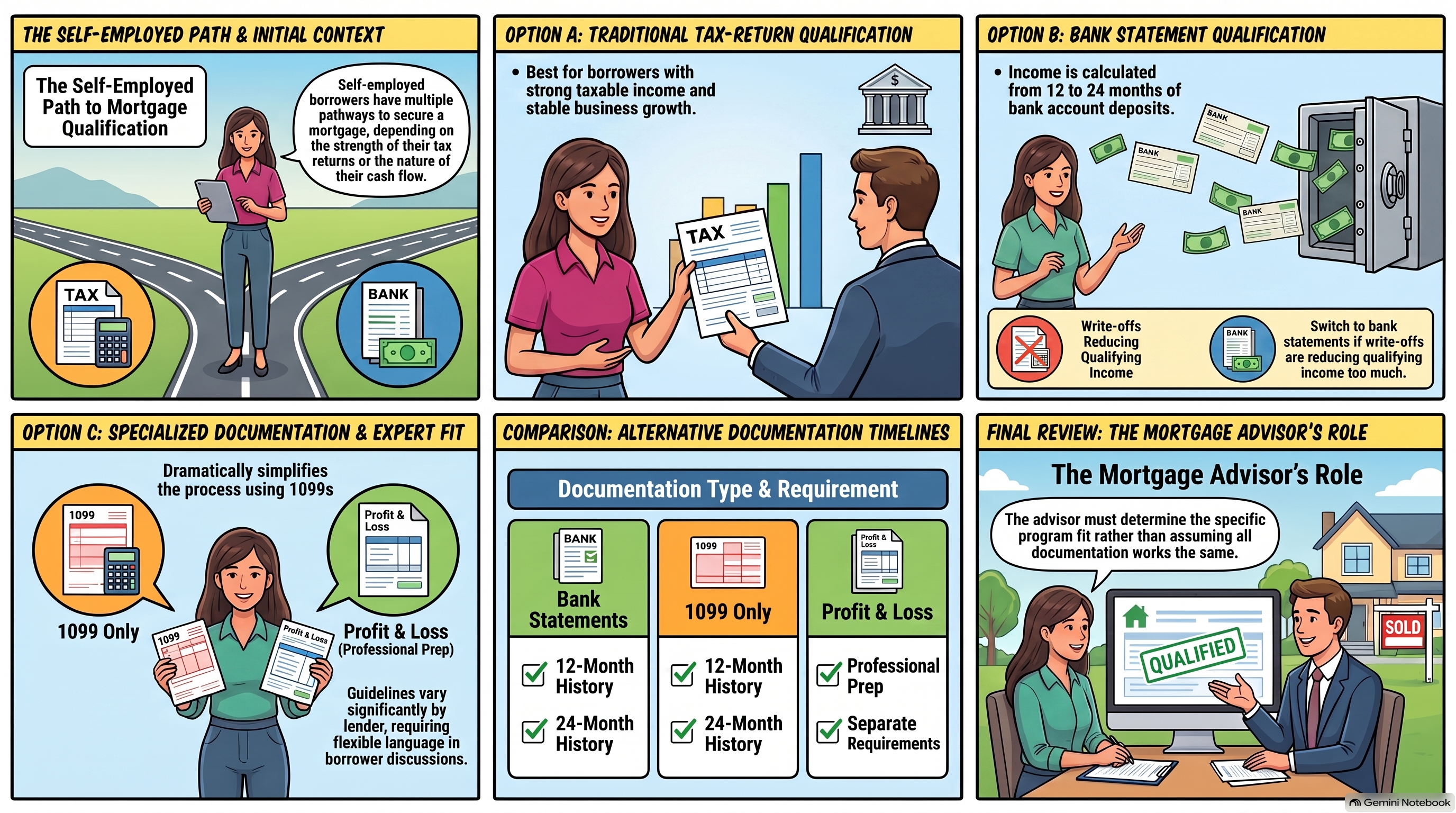
Self-employed buyers do not necessarily need a more difficult mortgage process. They usually need a more intentional one.
The biggest mistake is waiting until the buyer is under contract to figure out how their income will be documented.
Here are the questions Realtors should be asking early when working with a business owner, independent contractor, or 1099 borrower.
1. How long have you been self-employed?
This is one of the first things the mortgage advisor will want to know.
A borrower who has owned the same business for five years will generally have more qualification options than someone who became self-employed six months ago.
That does not mean a newer business owner automatically cannot qualify. Their prior employment history, industry experience, current business performance, and the loan program being considered can all matter.
What the Realtor should do:
Find out early and get the borrower connected with the lender before establishing a firm price range.
2. What type of business do you own?
The type of business can affect both the documentation required and how the income is analyzed.
Examples include:
- Sole proprietorship
- LLC
- Partnership
- S corporation
- Corporation
- Independent contractor or 1099 worker
The borrower does not need to explain the entire structure to the Realtor.
The goal is simply to identify that there is self-employed income so the mortgage advisor can determine what documentation will be needed.
What the Realtor should do:
Ask what the borrower does and how the business is structured, then let the lender handle the underwriting details.
3. How much of the business does the borrower own?
Ownership percentage matters.
Someone who owns a small interest in a company may be treated differently from someone who owns 100% of the business.
It can also determine whether business tax returns, K-1s, or additional business documentation are required.
What the Realtor should do:
Ask whether they own the business and, if so, approximately what percentage they own.
4. How does the borrower get paid?
Not every self-employed borrower receives income the same way.
They might receive:
- 1099 income
- Regular owner draws
- Payroll from their own company
- Distributions
- Commissions
- Direct business deposits
- A combination of several income sources
How the borrower receives money can help determine which mortgage qualification method makes the most sense.
What the Realtor should do:
Don't try to calculate it. Just identify how the borrower is paid and get the lender involved.
5. Does the borrower take significant tax deductions?
This question can completely change the mortgage strategy.
A business owner might legitimately generate substantial cash flow while reporting much lower taxable income because of business deductions.
For traditional mortgage qualification, those deductions can reduce the income available to qualify.
That is where alternative documentation programs such as bank statement, 1099, or profit-and-loss programs may become worth evaluating.
What the Realtor should do:
If the borrower says, “My accountant writes everything off,” that should trigger a deeper mortgage review.
6. Do self-employed buyers always need tax returns?
No.
Traditional conventional, FHA, VA, or USDA qualification may require tax-return analysis depending on the borrower's situation.
However, certain alternative-documentation programs may allow a borrower to qualify using other methods, such as:
- Personal bank statements
- Business bank statements
- 1099s
- Profit-and-loss statements
- Other approved income documentation
The right method depends on the borrower and the available loan program.
What the Realtor should do:
Never assume a buyer is disqualified just because their tax returns show low income.
7. Can bank statement deposits be used as income?
Potentially.
Bank statement programs may calculate qualifying income based on eligible deposits rather than relying primarily on taxable income.
But not every deposit counts.
Transfers between accounts, loan proceeds, refunds, and other non-income deposits may need to be excluded.
For business bank statements, business expenses also generally need to be considered.
What the Realtor should do:
Don't estimate qualification by looking at the account balance or total deposits. Have the lender perform the calculation.
8. Is a 1099 borrower automatically considered self-employed?
Not necessarily in every mortgage situation, but 1099 income should absolutely trigger a conversation with the mortgage advisor.
Depending on the borrower's circumstances and loan program, the income could potentially be analyzed through traditional documentation or an alternative 1099-based program.
What the Realtor should do:
When a buyer says, “I'm 1099,” don't immediately assume the loan will be difficult. Get the income reviewed.
9. What is a profit-and-loss mortgage program?
Certain mortgage programs may allow qualifying income to be based partly or primarily on a professionally prepared profit-and-loss statement rather than traditional tax-return income.
Program requirements vary significantly.
The lender may require:
- A specific history of self-employment
- A professionally prepared P&L
- Supporting bank statements
- Verification of the business
- Additional documentation depending on the investor
What the Realtor should do:
Know that the option exists. The mortgage advisor should determine whether it actually fits the client.
10. What if the buyer says they make $200,000 a year?
Ask what they mean.
That could mean:
- $200,000 in gross business revenue
- $200,000 in deposits
- $200,000 before business expenses
- $200,000 in personal income
- $200,000 on a 1099
- $200,000 in taxable income
Those are very different numbers from a mortgage qualification standpoint.
What the Realtor should do:
Never build a buyer's price range from the phrase, “I make about $200,000.”
Let the lender determine the qualifying income.
11. What if the buyer's business is doing much better this year?
That's helpful, but it does not automatically mean the lender can use all of the higher current income.
The mortgage advisor may need to evaluate:
- Prior-year income
- Current-year income
- Trends
- Stability
- Business history
- Whether the increase is likely to continue
A sharp increase may also need additional explanation or documentation.
What the Realtor should do:
Get the current numbers reviewed before assuming the higher revenue translates directly into more purchasing power.
12. What if the business income has declined?
Declining income deserves attention immediately.
The lender may need to determine:
- How large the decline is
- Why it happened
- Whether the decline has stabilized
- Whether the income is still considered likely to continue
A temporary decline does not necessarily kill the loan, but ignoring it until underwriting is a bad strategy.
What the Realtor should do:
Bring the lender into the conversation early.
13. Can the borrower use business funds for the down payment and closing costs?
Potentially, but this needs to be reviewed before money is moved.
Depending on the loan type and business structure, the lender may need to verify that withdrawing the funds will not negatively affect the business.
The documentation requirements can vary substantially.
What the Realtor should do:
Tell the buyer not to start transferring large amounts of business money into personal accounts just because they are preparing to make an offer.
Have the lender review the source of funds first.
14. Should the buyer move money around to make their bank statements look cleaner?
Usually, no.
Moving money between multiple accounts can actually create more documentation.
Large transfers may need to be traced, and the same funds cannot simply be counted multiple times as income.
What the Realtor should do:
Encourage the borrower to speak with the lender before making unusual transfers during the mortgage process.
15. Should a self-employed buyer wait until after filing their next tax return to apply?
Not automatically.
The new return could help.
It could also hurt.
If the borrower takes substantial additional deductions, changes the business structure, or reports significantly different income, qualification could change.
What the Realtor should do:
Have the mortgage advisor review the numbers before the borrower makes a mortgage-driven tax decision.
16. Are bank statement loans only for borrowers with bad credit?
No.
A bank statement mortgage is primarily an alternative method of documenting income.
A borrower may have excellent credit, substantial reserves, and a highly profitable business but still benefit from bank statement qualification because their tax returns do not reflect their actual cash flow.
What the Realtor should do:
Don't position alternative-documentation loans as a last-resort product for weak borrowers.
17. Will a self-employed buyer have a higher interest rate?
Sometimes.
Alternative-documentation programs can have different pricing than conventional financing.
However, rate is only one part of the decision.
If one program qualifies the borrower for the home they actually want while another does not, the mortgage advisor should compare the complete options, including:
- Rate
- Payment
- Down payment
- Closing costs
- Documentation
- Qualification amount
- Long-term strategy
What the Realtor should do:
Don't dismiss a program based solely on the fact that it is not conventional.
18. When should the Realtor send the borrower to the lender?
As early as possible.
Ideally, before serious home shopping begins.
A self-employed buyer's qualification should not be based on a five-minute conversation about gross income.
Whenever possible, the lender should review the actual documentation and determine how much qualifying income can be supported.
What the Realtor should do:
The moment a buyer says they are self-employed, 1099, an independent contractor, or a business owner, introduce the mortgage advisor.
The Five Questions Every Realtor Should Ask
You do not need to become an expert in self-employed underwriting.
You only need to identify when a deeper review is needed.
Ask:
- How long have you been self-employed?
- What type of business do you own, and how much of it do you own?
- How are you paid?
- Do you take significant business deductions on your tax returns?
- Has a mortgage advisor already reviewed your actual income documentation?
If the answer to number five is no, that's the next step.
The Realtor Rule
Don't diagnose the loan. Identify the self-employed borrower and bring the lender in early.
The earlier the income is reviewed, the easier it is to establish a realistic price range, choose the right financing strategy, and avoid discovering a qualification problem after the buyer is already under contract.